
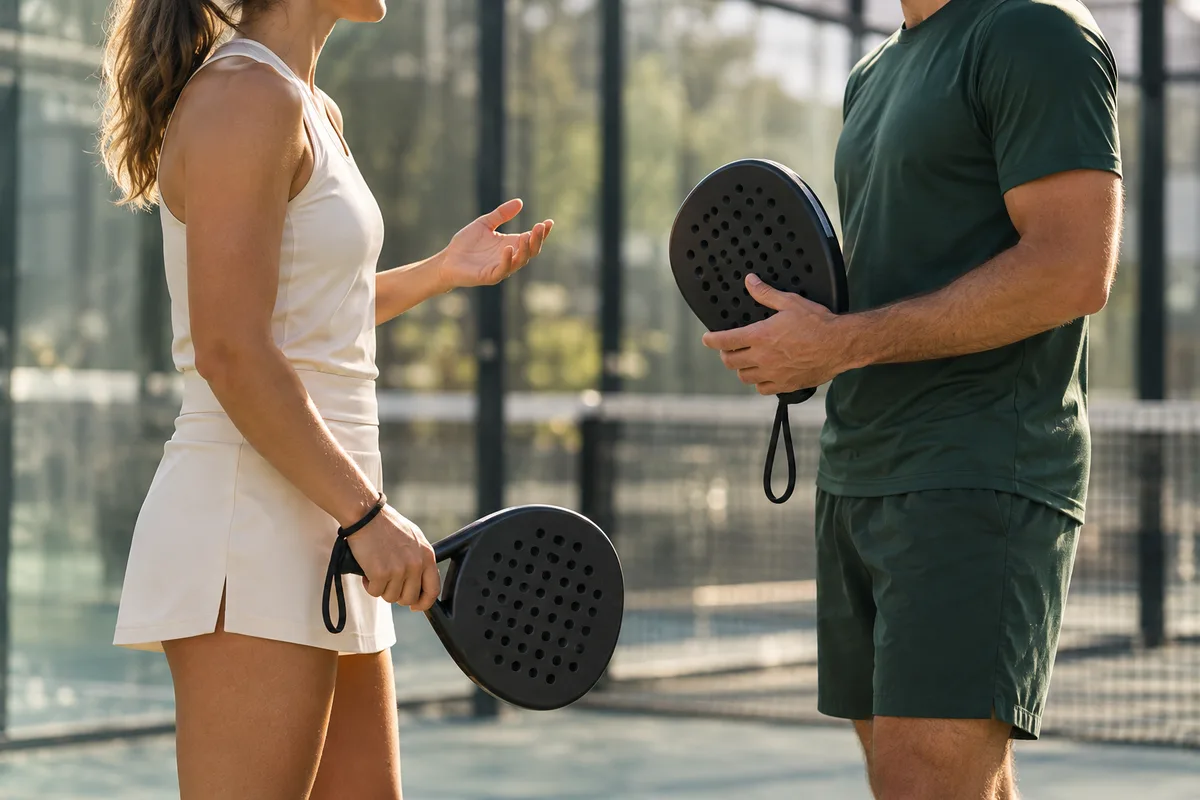

You do not need a complicated playbook to become an easier partner to play with. Start by knowing where the other player is, sharing the middle and using a few clear calls.
Think about the space between you
The LTA’s beginner guidance recommends working as a team: typically both players forward when attacking and both back when defending. It also explains how a lob can help a pair move forward. Read its beginner skills guide for the underlying coaching advice.
Use that as a starting point, not a command to rush the net after every shot. In a practice session, pause occasionally and notice where you both finished. If one player is near the net and the other is still at the back, discuss what each expected to happen. The useful question is “How could we move together next time?”
Decide who takes the middle
Before playing, talk about balls that travel between you. Handedness, position and the incoming ball all affect the decision; there is no need to pretend that one player should take every middle ball.
Agree an early call. If you call “mine”, do it while your partner still has time to respond. If the situation is unclear, stop and reset safely instead of both committing to a swing. After the rally, discuss that particular ball without turning it into a judgement about your partner’s ability.
Keep a small vocabulary
- “Mine”: I am taking this ball.
- “Yours”: you have the clearer play.
- “Back”: we need to retreat together.
- “Up”: there is an opportunity to move forward together.
These are suggested practice calls, not official commands. Pick words you both understand. Avoid long instructions while someone is preparing a shot, and do not assume a shouted call makes an unsafe movement safe.
A ten-minute partnership exercise
- Spend two minutes agreeing calls and discussing the middle.
- Play several gentle rallies with one aim: know your partner’s position before your next shot.
- Pause after each rally and describe where both of you ended up.
- Repeat, adding one agreed movement call where it helps.
- Finish by choosing one habit to carry into the match.
Keep the pace comfortable enough to observe what is happening. If your group has a coach, ask them to identify one positioning change rather than trying to fix everything at once.
Use the break between games well
Share one observation and one proposal. “We both went for the same middle ball; let’s call earlier” is clear and actionable. Replaying every missed shot is less useful. Ask what your partner needs, especially if you are playing together for the first time.
After the session, record the call or movement that helped most. Progress is easier to notice when you repeat the same small objective. If defensive rebounds are separating you, work through our guide to the back glass together before your next match.